
Preferans: basics
Preferans is a trick-taking card game for three or four players. It is played in deals; in each deal one player (the declarer) undertakes to take at least the number of tricks they named, and the others try to stop them. Everything goes into the score sheet — the pool, the mountain and the whists — and at the end of the game every player wins or pays whists. This page covers what all variants share; differences are in Leningrad, Sochi and Rostov.
Deck and deal
A 32-card deck: seven to ace in each suit. Each active player gets 10 cards; two go face down to the talon.
With four players the dealer sits out the deal: no cards, no bidding, no play. The dealer's seat moves around the table every deal, so everyone sits out one deal in four. With three players the dealer plays like everyone else.
Bidding
The player left of the dealer (with four — the first active player) speaks first, then clockwise. Bids are games in rank order:
6♠ < 6♣ < 6♦ < 6♥ < 6 NT < 7♠ < … < 10 NT
The number is how many tricks, the suit is trumps, NT is no trumps. Each bid must be higher than the previous one. The senior hand (earlier in turn order) may say "here" — repeat the junior hand's game; the junior hand must then bid higher or pass. Once you pass you are out of the bidding.
Misère is a promise to take no tricks at all. It may only be your first bid; it ranks above 8 NT and below 9♠, so after a misère only nine-level games can be bid. A misère bidder can only pass afterwards.
Bidding ends when all but one have passed; that player is the declarer. If everyone passes, raspasy (all-pass) is played.
Talon, discard and contract
The talon is shown to everyone and goes into the declarer's hand. The declarer discards any two cards face down — nobody sees the discard — and names the contract: no lower than their last bid. Misère has no contract.
Whist
The other two, starting left of the declarer, say whist (play against) or pass. Together the whisters must take at least:
| Game | 6 | 7 | 8 | 9 | 10 |
|---|---|---|---|---|---|
| Tricks for the whisters | 4 | 2 | 1 | 1 | 1 |
- Both pass — the game counts as made without play.
- On six and seven, if the first passed, the second may say half-whist: the game is scored as made and they get whists for half the obligation. The first may take the whist back — then the deal is played and they whist alone.
- Both whist — each plays their own cards, closed.
- One whists — they choose to play open (their cards and the passer's are shown to all and they play both hands) or closed.
Play
The first lead is always by the first hand, whoever declared. You must follow suit; with no cards of the suit you must trump; with no trumps either you may play anything. The highest trump wins the trick, or, with no trumps, the highest card of the suit led. The winner leads next.
Misère has no trumps. The catchers open their cards before the first lead, or after the misère player's first card if the misère player leads. The misère hand stays closed.
Raspasy
When everyone passes, each plays for themselves and tries to take as few tricks as possible. How the talon is used and how tricks are scored depends on the variant. Consecutive raspasy cost more (progression), and you leave them with a game — after raspasy the bidding starts no lower than the exit game.
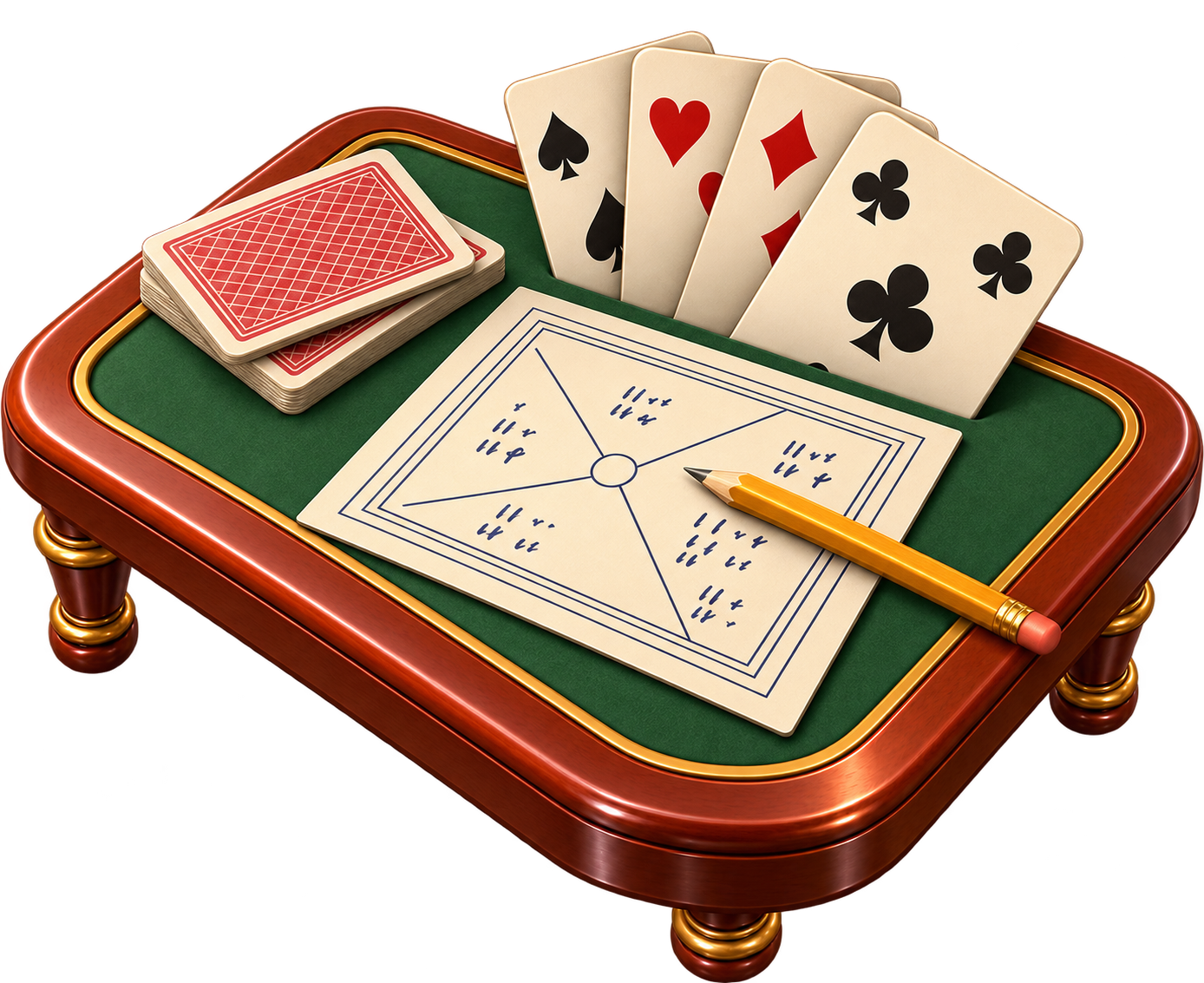
Score sheet
- Pool — points for games made: 6 — 2, 7 — 4, 8 — 6, 9 — 8, 10 — 10, misère — 10.
- Mountain — penalties: for a declarer's undertricks, the whisters' shortfall, tricks in raspasy, tricks on misère.
- Whists — who on whom: whisters write whists on the declarer for their tricks, and consolation for the declarer's undertricks. With four players the dealer writes consolation too.
End of the game
The game runs to the pool length chosen in the challenge. The result in whists puts everything together: a pool above the average is a plus, a mountain above the average is a minus, and mutual whists cancel out in pairs. The results of all players sum to zero. Places by result go into the rating.